
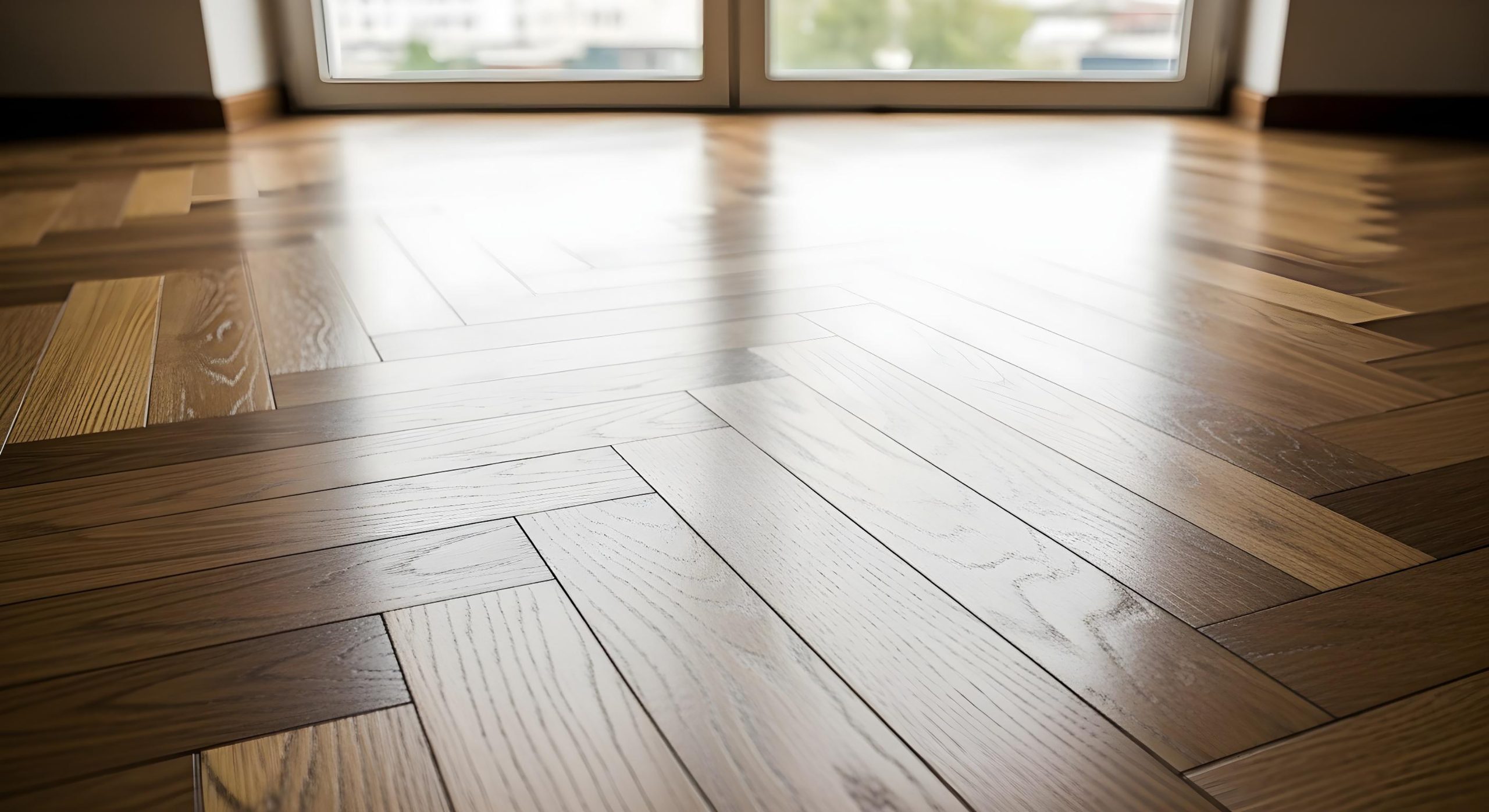
The main difference between prefinished and unfinished hardwood flooring is where the boards are sanded, stained, and sealed.
Prefinished hardwood receives its stain and protective coating at the factory before installation. Unfinished hardwood is installed in its raw state and then sanded, stained, and finished inside the home.
Prefinished hardwood is usually better when faster installation, less dust, and predictable color are priorities. Unfinished hardwood is often better when homeowners want a custom stain, a smooth surface without pronounced beveled edges, or a closer match to existing flooring.
Both options can provide a durable, attractive floor when the material is selected correctly and installed professionally.
Prefinished vs. Unfinished Hardwood: Quick Comparison
| Feature | Prefinished hardwood | Unfinished hardwood |
|---|---|---|
| Where it is finished | At the factory | Inside the home |
| Installation time | Usually faster | Usually longer |
| On-site sanding | Not normally required | Required |
| On-site stain and finish | Not normally required | Required |
| Dust and odor | Less | More |
| Color customization | Limited to available products | Extensive |
| Edge appearance | Often micro-beveled | Generally smoother after sanding |
| Finish consistency | Factory controlled | Depends on site preparation and application |
| Matching existing floors | Can be challenging | Usually provides greater flexibility |
| Immediate availability | No finish-curing delay, but installation requirements still apply | Requires drying and curing |
| Future refinishing | Depends on product thickness | Depends on board thickness and condition |
| Best for | Faster, lower-disruption projects | Custom colors and integrated flooring |
What Is Prefinished Hardwood Flooring?
Prefinished hardwood is sanded, stained, and coated in a controlled factory environment. The finished boards are delivered to the home ready for installation.
The category can include:
- Prefinished solid hardwood
- Prefinished engineered hardwood
- Various wood species
- Multiple colors and sheens
- Smooth, wire-brushed, or textured surfaces
Because the coating is already cured, the flooring does not require sanding, staining, and finishing after installation. However, adhesive, transitions, trim, and other installation components may still require time before normal use.
Advantages of Prefinished Hardwood Flooring
Faster Installation
Prefinished boards eliminate the on-site sanding, staining, coating, and curing stages. This can shorten the project and reduce the time rooms remain unavailable.
The precise schedule depends on:
- Size and layout of the room
- Subfloor preparation
- Installation method
- Removal of old flooring
- Repairs
- Transitions and trim
- Material acclimation
- Adhesive requirements
Less Dust and Odor
Because the boards are finished at the factory, there is usually no on-site sanding dust or finish odor associated with coating a new floor.
Cutting, subfloor preparation, and installation can still create some dust and debris, but the disruption is generally lower than with unfinished hardwood.
Consistent Factory Appearance
Factory-controlled application can provide consistent color, sheen, and coating thickness across the product.
Homeowners can select the flooring from manufacturer samples and view finished boards before installation. Natural wood variation will still be present and should be considered when selecting the material.
Durable Factory-Applied Coatings
Many prefinished hardwood products use durable multi-coat finish systems. Some include aluminum oxide or other wear-resistant technology.
The specific performance depends on the manufacturer, product line, finish system, maintenance, and household conditions. Not every factory finish has the same durability.
No On-Site Finish Cure Period
The factory finish is already cured when the boards arrive. Homeowners do not need to wait for a newly applied floor finish to cure after installation.
This does not always mean the room can be used immediately. Follow the installer’s instructions for adhesive curing, transitions, furniture, appliances, and other project-specific requirements.
Disadvantages of Prefinished Hardwood Flooring
Less Color Customization
Homeowners must select from the colors, sheens, textures, widths, and species offered by the manufacturer.
Finding an exact match for existing hardwood, stairs, cabinets, or trim can be difficult, especially when the existing wood has changed color with age and sunlight.
Visible Edges Between Boards
Many prefinished boards have micro-beveled edges. These help accommodate slight differences between individual boards, but they create visible lines across the floor.
Some homeowners like the definition between planks. Others prefer the smoother, more continuous appearance of a site-finished floor.
Dirt Can Collect Along Beveled Edges
Beveled seams may collect dust or debris and require additional attention during cleaning. The effect varies depending on the depth of the bevel and the product.
Local Repairs May Be Noticeable
Replacing a damaged prefinished board may create a color or sheen difference if the surrounding floor has aged, faded, or the original product is no longer available.
Some localized damage can be repaired, but the best method depends on the finish and depth of the scratch.
Product Matching Can Become Difficult
If additional flooring is needed years later, the exact color, width, finish, or product line may have changed or been discontinued.
Purchasing a reasonable amount of extra material during the original installation can help with future board replacement.
What Is Unfinished Hardwood Flooring?
Unfinished hardwood is installed without factory-applied stain or final protective coating. After installation, the floor is sanded as one continuous surface, and the selected stain and finish are applied on-site.
Unfinished flooring is commonly chosen when homeowners want:
- A custom stain
- A specific finish system
- Greater control over sheen
- A smoother surface
- A match to existing hardwood
- New flooring woven into older boards
- Coordinated floors and stairs
Advantages of Unfinished Hardwood Flooring
Greater Stain Customization
Unfinished hardwood allows stain samples to be applied directly to the installed floor. This helps homeowners evaluate colors under their own lighting and beside walls, cabinets, furniture, and existing woodwork.
Standard stain colors may also be adjusted or blended when a custom result is needed.
See our Minwax hardwood floor stain color guide for examples of popular light, medium, and dark directions.
Smoother Surface
Because unfinished flooring is sanded after installation, minor height differences between boards can be reduced. The finished surface generally looks more continuous than flooring with visible factory-beveled edges.
This can be especially attractive in formal rooms, historic homes, and projects requiring a seamless appearance.
Better Option for Matching Existing Hardwood
Unfinished flooring provides greater flexibility when extending hardwood into another room or repairing an existing floor.
A professional may:
- Identify the existing species
- Weave new boards into the old floor
- Sand connected areas
- Apply test stains
- Adjust the color formula
- Finish the surfaces together
An exact match is not always possible because old and new wood may absorb stain differently, but site finishing generally provides more control.
Learn more about matching new floor stain to existing wood tones.
Flexible Finish and Sheen Options
Homeowners can choose the stain, finish system, and sheen appropriate for the project.
Common sheen options include:
- Matte
- Satin
- Semi-gloss
- Gloss
Compare their appearance and maintenance in our guide to matte vs. satin hardwood floor finishes.
Easier Integration With Stairs and Custom Details
Site-finished flooring can be coordinated with stair treads, borders, medallions, vents, and connected rooms. This makes unfinished hardwood useful for custom or historically sensitive projects.
Disadvantages of Unfinished Hardwood Flooring
Longer Project Schedule
The floor must be installed, sanded, prepared, stained when requested, and protected with multiple finish coats.
Drying and curing requirements vary by product. The flooring contractor should provide a project-specific schedule for foot traffic, furniture, rugs, cleaning, and normal use.
More On-Site Disruption
Sanding produces dust, even when modern containment equipment is used. Stains and finishes may also create odors depending on the products selected.
Danzco uses modern dust-containment equipment and estimates approximately 80% containment. Homeowners should still expect some cleanup.
Rooms Remain Unavailable Longer
Unfinished flooring requires time for sanding, stain application, finish coats, drying, and curing. Homeowners may need to make temporary arrangements for furniture, pets, and access to affected rooms.
Final Color Depends on Several Variables
The result is influenced by:
- Wood species
- Natural undertones
- Sanding
- Stain application
- Lighting
- Number of coats
- Finish product
- Sheen
This is why on-floor samples and professional application are important.
Is Prefinished Hardwood More Durable?
Prefinished hardwood is not automatically more durable in every situation, but many products have highly wear-resistant factory coatings.
Durability depends on:
- Manufacturer and product line
- Finish system
- Number of coats
- Wood species
- Household traffic
- Cleaning practices
- Pets
- Moisture exposure
- Installation quality
Site-finished hardwood can also provide excellent long-term performance when a suitable professional finish system is applied correctly.
The ability to conceal future scratches is different from resistance to scratching. Factory coatings may resist wear well, but a scratch across a dark or uniform prefinished board may still be visible.
Is Prefinished or Unfinished Hardwood More Expensive?
The final cost depends on the complete project rather than the board price alone.
Prefinished flooring may have a higher material price, but it generally requires less on-site finishing labor.
Unfinished flooring may have a lower initial material price, but the total includes:
- Sanding
- Stain
- Finish
- Additional labor
- Drying time
- Dust containment
- Room downtime
Other major cost factors include:
- Wood species
- Board width
- Solid or engineered construction
- Subfloor preparation
- Removal of existing flooring
- Stairs and transitions
- Repairs
- Room layout
- Installation method
Request estimates based on the same project scope before comparing the two options.
Which Is Easier to Repair?
The answer depends on the damage.
A severely damaged prefinished board may be replaced individually if a matching product is available. However, differences in age, color, and sheen can make the replacement visible.
Site-finished hardwood may provide greater flexibility for blending localized repairs, especially when adjacent boards can be sanded and finished together.
Widespread wear generally requires professional evaluation regardless of how the floor was originally finished.
Can Prefinished Hardwood Be Refinished?
Yes, many prefinished hardwood floors can be refinished.
Prefinished solid hardwood may often be sanded and refinished multiple times, depending on its thickness and previous sanding.
Prefinished engineered hardwood may or may not be suitable for sanding. The contractor must inspect the real-wood wear layer and product construction.
Beveled edges may also affect the appearance and amount of sanding required.
Can Unfinished Hardwood Be Refinished?
Yes. Solid unfinished hardwood is typically selected partly because of its long-term refinishing potential.
The number of possible refinishing projects depends on:
- Board thickness
- Previous sanding
- Depth of damage
- Fastener position
- Remaining wood above the tongue and groove
No floor should be sanded repeatedly without first checking its condition.
Read more about how long hardwood floors last.
Which Is Better for Homes With Pets?
Both types can work in homes with pets.
Consider:
- Wood hardness
- Stain color
- Grain variation
- Finish sheen
- Scratch visibility
- Ability to obtain replacement boards
- Maintenance expectations
Light-to-medium natural colors, visible grain, and matte or satin finishes generally make scratches and pet hair less noticeable.
For additional help, see which hardwood floor colors hide dirt and scratches best.
Which Is Better for a Fast Renovation?
Prefinished hardwood is generally better when homeowners want to reduce on-site work and return rooms to service sooner.
It may be appropriate when:
- The project has a limited schedule.
- The home will remain occupied.
- On-site finish odor is a concern.
- The desired color is available as a factory product.
- Matching existing flooring is not required.
The installer still needs time for acclimation, subfloor preparation, cutting, installation, trim, and any adhesive curing.
Which Is Better for an Older Maryland Home?
Unfinished hardwood may be preferable when renovating an older home with existing wood flooring, custom stairs, uneven transitions, or a color that must be matched.
It allows the contractor to sand the new installation and connected flooring together, apply samples, and coordinate the final color and sheen.
Prefinished hardwood may still be appropriate when the room is separate from existing flooring or when speed and lower disruption are more important than a seamless match.
How to Choose Between Prefinished and Unfinished Hardwood
Choose prefinished hardwood if:
- You want a faster installation.
- You want less dust and finish odor.
- You prefer to see the finished product before installation.
- A suitable factory color and sheen are available.
- You do not need to match existing hardwood precisely.
- Minimizing room downtime is important.
Choose unfinished hardwood if:
- You want a custom stain.
- You want a smoother site-sanded appearance.
- New flooring must coordinate with existing boards.
- Floors and stairs need to match.
- You want greater control over the finish system.
- Additional project time is acceptable.
Neither option is universally better. The correct choice depends on the subfloor, room, timeline, design, existing flooring, budget, and long-term expectations.
Frequently Asked Questions
What is the main difference between prefinished and unfinished hardwood?
Prefinished hardwood is stained and coated at the factory before installation. Unfinished hardwood is installed raw and then sanded, stained, and finished inside the home.
Is prefinished hardwood cheaper than unfinished hardwood?
Not always. Prefinished material may cost more, while unfinished flooring requires additional sanding, staining, finishing, and labor. Compare the complete installed price.
Can you walk on prefinished hardwood immediately?
The factory coating is already cured, but the installation system may still require restrictions. Follow the installer’s instructions regarding adhesive, furniture, appliances, and normal traffic.
Does prefinished hardwood have beveled edges?
Many products have micro-beveled edges, although the profile varies. These edges make individual boards more visible than a site-sanded floor.
Which option provides more stain colors?
Unfinished hardwood provides greater customization because stain samples and custom blends can be applied directly to the installed flooring.
Can prefinished floors be sanded and refinished?
Many can, particularly solid hardwood. Engineered flooring depends on the thickness of its real-wood wear layer and must be inspected first.
Which type is better for matching an existing floor?
Unfinished hardwood usually provides more flexibility because the new and existing flooring can be sampled, sanded, stained, and finished together.
Which hardwood is better for resale value?
Both may add value when professionally installed and appropriate for the home. Condition, material quality, appearance, and consistency between rooms are more important than whether the boards were factory- or site-finished.
Hardwood Floor Installation in Baltimore, MD
Choosing between prefinished and unfinished hardwood requires evaluating the home, subfloor, existing flooring, timeline, design goals, and long-term maintenance needs.
Danzco Hardwood Floors has served Baltimore and surrounding Maryland communities since 1988. Our NWFA-certified team installs unfinished and prefinished hardwood, engineered flooring, luxury vinyl plank, stairs, treads, risers, borders, transitions, and wood vents.
Call (410) 788-5919 or contact Danzco Hardwood Floors online to schedule an on-site estimate.